

Artificial Intelligence (AI) is no longer just an academic topic—it’s the backbone of smart assistants, self-driving cars, medical diagnosis systems, and even financial trading bots. At the heart of AI lies one important concept: the Rational Agent in AI.
Thank you for reading this post, don't forget to subscribe!As someone deeply involved in AI research and practical applications, I’ve seen how rationality shapes real-world AI systems. This guide explains, in simple terms, what a rational agent is, why it matters, and how it connects to areas like economics, philosophy, and intelligent agents. By the end, you’ll understand not only the theory behind rational agents but also how they work in practice in 2025.
🟢 Quick Answer: What is a Rational Agent in AI?
A rational agent in AI is an intelligent system designed to make the best decision possible in a given situation using percepts (inputs), knowledge, and actions.
👉 In simple words: A rational agent is a program or machine that acts smartly to maximise its chances of success – based on what it knows at that moment.
- Input: The environment it is in
- Decision-making: What’s the best action given current knowledge
- Output: The action it takes
For example, a self-driving car analysing traffic is a rational agent. It uses sensors (cameras, radar), processes data, and decides whether to stop, accelerate, or turn—always aiming for safety and efficiency.
📌 Outline of This Guide
- Introduction to Rational Agents in AI
- Key Elements of a Rational Agent
- Rationality in AI: Core Concepts
- Rational Agent Diagram Explained
- Ideal Rational Agent in AI
- Examples of Rational Agents
- Rational Agent vs Intelligent Agent
- Rational Agent in Economics vs AI
- Rational Agent Philosophy
- Applications in 2025 and Beyond
- Rational Agent in AI (Javatpoint reference explained simply)
- FAQs (with mini-answers)
- Final Thoughts
1. Introduction to Rational Agents in AI
AI systems are often designed to be agents—entities that observe the world and take actions. But not every agent is “smart.”
- A machine that responds randomly is just an agent.
- A rational agent is one that makes decisions with purpose and for a goal.
This difference defines the intelligence of AI.
Core takeaway: Rational agents are the foundation of decision-making models in AI. Without rationality, AI would act unpredictably.
2. Key Elements of a Rational Agent
Every rational agent has four main parts:
- Percepts → Inputs from the environment (e.g., camera images, sensor signals).
- Knowledge Base → What the agent knows about the world.
- Decision Logic → Rules, algorithms, or machine learning models used to reason.
- Actions → The outcome or behavior chosen.
Formula (simplified): Rationality = Best possible action (given percept history + knowledge + performance measure).
3. Rationality in AI: Core Concepts
The meaning of rationality in AI depends on performance measures, not instantaneous success.
- Rational Action ≠ Perfect Action
It means the action is reasonable based on what the agent knows, even if the outcome isn’t always right.
Example: A delivery drone chooses the shortest safe route based on live weather data. If suddenly a storm appears it couldn’t predict, it’s still rational—it acted on the best data it had.
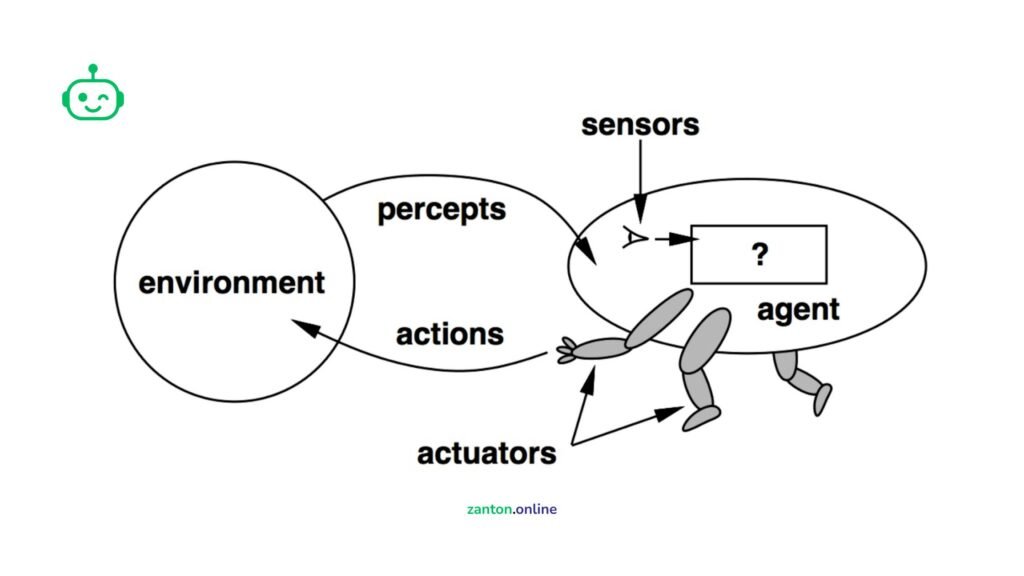
4. Rational Agent in AI Diagram (Explained Simply)
A typical rational agent diagram looks like this:
Environment → Sensors → Percepts → Agent → Decision System → Actions → Environment again
- Sensors capture percepts (like human eyes/ears).
- The agent processes data using AI models.
- Actions influence the environment (like moving a robot arm).
- It’s a closed feedback loop.
If you search rational agent diagram ChatGPT, you’ll see the same loop of perception, thinking, acting.
5. Ideal Rational Agent in AI
The ideal rational agent in AI is a theoretical model. It assumes:
- Complete knowledge of the environment
- Unlimited computational resources
- Always choosing the best possible action
In reality, agents are boundedly rational—they make the best decisions within limitations (processing time, limited sensors, incomplete data).
6. Rational Agent in AI Example
Let’s explore some real-world examples:
- Self-driving cars → Rational agent that balances speed, safety, and rules.
- Voice assistants (Siri, Alexa, etc.) → Rational agents that listen, process queries, and deliver best answers.
- Medical AI systems → Suggest treatments based on patient data for best recovery.
- Netflix recommendation system → Chooses which shows to suggest to maximize engagement.
Each uses AI techniques (ML, deep learning, expert systems) to behave rationally in its environment.
7. Rational Agent vs. Intelligent Agent in AI
- Intelligent agent in AI: Any system that can perceive and act.
- Rational agent in AI: A subset of intelligent agents that make goal-directed, best possible actions.
👉 All rational agents are intelligent, but not all intelligent agents are rational.

8. Rational Agent in Economics vs AI
- In economics, a rational agent is assumed to act in ways that maximize utility or profit. Example: Buyers seeking best value for money.
- In AI, rationality means selecting the best feasible action under uncertainty, limited data, or incomplete knowledge.
Bridge point: Rational agent in AI borrows the theory from economics but adapts it to machines.
9. Rational Agent Philosophy
The idea of the rational agent philosophy comes from centuries of thought: humans are rational beings making goal-directed choices.
But AI challenges this:
- Humans often act irrationally (biases, emotions).
- Machines can sometimes be more rational—as they don’t have biases.
Thus, philosophy debates: Can AI truly be rational if it lacks human “reasoning” and values?
10. Applications of Rational Agents in 2025
Rational agents shape the most advanced AI tools today:
- Healthcare: Personalized medicine using rational choice models.
- Finance: Trading bots optimizing for maximum profit under uncertainty.
- Robotics: Smart drones, warehouse robots.
- Education: Adaptive learning platforms.
- Customer Support: AI chatbots using rational analysis to give best responses.
11. Rational Agent in AI (Javatpoint Reference Simplified)
Many readers come across “Rational Agent in AI Javatpoint”. While that article provides technical depth, here’s the clean version:
- Agent: Anything that perceives and acts.
- Rational agent: Chooses the best valid action for its task.
- It follows the rule: Do what is right, given what you know.
So, Javatpoint and other technical sites lay the foundation, but here we put it in real-world, simple terms.

12. FAQs on Rational Agents in AI
Q1. What is the rational agent model?
It’s a framework in AI where agents act to maximise performance based on percepts and knowledge.
Q2. What is a rational approach in AI?
It’s the method of designing AI systems to select the best possible actions.
Q3. What is meant by a rational agent in AI?
An agent that acts to achieve its goals in the most effective way.
Q4. What are the types of AI?
Reactive AI, Limited Memory AI, Theory of Mind AI, and Self-aware AI.
Q5. What is an agent and types of agents?
An agent is anything that perceives and acts. Types include: Simple Reflex Agents, Model-based Reflex Agents, Goal-based Agents, Utility-based Agents, and Learning Agents.
Q6. What are the 5 types of agents in AI?
- Simple Reflex
- Model-based
- Goal-based
- Utility-based
- Learning Agents
Q7. What is the rationale in AI?
The reasoning or logic behind why AI makes a certain decision.
Q8. What is an example of rationality in AI?
A navigation AI choosing the fastest safe route avoiding traffic.
Q9. What is the rational agent access model?
It’s about how rational agents access percepts, process them, and choose actions to meet performance goals.
Q10. What are the 4 perspectives of AI?
- Acting humanly
- Thinking humanly
- Acting rationally
- Thinking rationally
Q11. Are humans rational agents?
Humans aim to be rational, but emotions and biases mean we aren’t always ideally rational.
Q12. What is a simple reflex agent in AI?
It’s the most basic agent that works on if-then rules without memory. Example: A vacuum robot turning when hitting a wall.
13. Final Thoughts
The rational agent in AI is the backbone of modern intelligent systems. Whether in economics, robotics, or daily AI tools, rational agents help machines make the best possible decisions—even when the environment is uncertain.
In 2025, as AI systems become more complex, understanding rational agents is crucial for developers, researchers, and users alike.
👉 Remember this: A rational agent isn’t perfect—it’s simply the smartest possible decision-maker for the knowledge it has.





[…] Integrations: ChatGPT, Microsoft Copilot, API use, and enterprise AI […]
[…] AI agent is simply an AI model (like GPT-4, Claude, or others) combined with the ability to take actions […]