As an AI engineer with over a decade of experience watching artificial intelligence evolve from a niche academic field into a world-changing force, I’ve seen countless trends come and go. But nothing has prepared me for the seismic shift we’re witnessing with the rise of agentic AI.
Thank you for reading this post, don't forget to subscribe!This isn’t just another buzzword; it’s the next chapter in the story of technology, a leap from AI that can generate to AI that can act.
Agentic AI, at its core, refers to AI systems that can independently and proactively take actions to achieve a set of goals. Unlike their generative counterparts, which need a specific prompt to create text or images, agentic systems can plan, reason, and execute multi-step tasks in the digital or physical world. Think of it as the difference between a brilliant writer who can draft an email for you (Generative AI) and a highly efficient personal assistant who not only drafts the email but also schedules the follow-up meeting, books the restaurant, and adds it all to your calendar without you lifting a finger (Agentic AI).
This capability is setting the stage for a technological revolution. We’re about to explore the seven most important agentic AI trends that are not just on the horizon but are actively beginning to dominate the tech landscape.
What is Agentic AI? From Assistants to Actors
To truly grasp the incoming wave, we first need to understand what is agentic AI. Imagine you want to plan a vacation.
- A traditional AI (like a search engine) would give you a list of websites when you search “best beaches in Italy.”
- A generative AI (like ChatGPT) could write you a detailed itinerary if you ask it to.
- An agentic AI would take your goal—”plan a 10-day trip to Italy for two in September on a $5,000 budget”—and then do it. It would research flights, compare hotels, check for rental car availability, book tickets, and present you with a completed plan, all while staying within your constraints.
This is the essence of agentic AI meaning: it’s about goal-oriented action. These systems operate on a loop of perception, planning, and execution. They perceive their environment (digital or physical), create a step-by-step plan to achieve a goal, and then execute that plan, learning and adapting along the way.
The agentic AI architecture often involves several components working together:
- Perception Module: Gathers information and understands the current state.
- Planning Module: Breaks down a large goal into smaller, manageable tasks.
- Action Module: Executes the tasks, using tools like web browsers, APIs, or other software.
- Memory Module: Retains information from past actions to learn and improve future performance.
This shift from passive generation to active execution is why the distinction between agentic AI vs AI agents is so crucial. While “AI agent” is a broader term for any program that acts on behalf of a user, “agentic AI” describes the new, sophisticated intelligence that allows these agents to operate with unprecedented autonomy and capability.
Agentic AI vs Generative AI: The Critical Difference
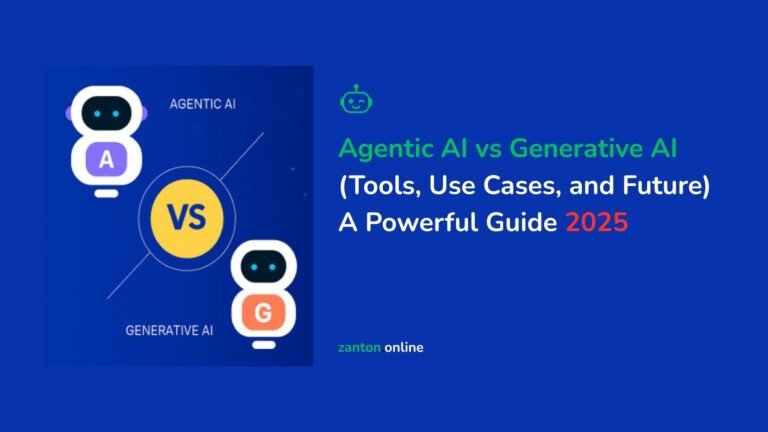
One of the most common points of confusion is the difference between agentic and generative AI. While they are related—many agentic systems use generative models for planning or communication—their core functions are distinct.
Treat this section as a mini-blog to clarify the debate around agentic AI vs generative AI. Generative AI is a master of creation. It excels at producing new content. Agentic AI, on the other hand, is a master of execution. It excels at getting things done.
Here’s a simple table to make the comparison clear:
| Feature | Generative AI | Agentic AI |
| Primary Function | To create new content (text, images, code). | To achieve goals by taking action. |
| Interaction Model | Responds to specific user prompts. | Operates autonomously based on high-level goals. |
| Core Capability | Pattern recognition and content generation. | Planning, reasoning, and task execution. |
| Analogy | A brilliant but passive specialist (e.g., a writer, an artist). | A proactive and versatile assistant or team member. |
| Example | Asking an AI to write a marketing email. | Telling an AI to launch a marketing campaign (which includes writing the email, identifying a target list, sending it, and tracking results). |
The future isn’t about one replacing the other. Instead, agentic systems will leverage the power of generative models as one of their many tools to understand the world and communicate, making them even more powerful.

Top 7 Agentic AI Trends That Will Dominate the Tech Landscape
Now that we have a solid foundation, let’s dive into the seven key trends that showcase how agentic AI is reshaping our world.
1. The Rise of the AI Coworker in the Enterprise
The concept of a “copilot” is evolving into a true digital teammate. Companies are moving beyond simple AI assistants that suggest email replies and towards sophisticated agentic systems that can manage entire workflows.
What this means: Imagine an AI agent integrated into your project management software. You assign it a task like “Launch the new Q3 marketing initiative.” The agent then creates sub-tasks for team members, schedules kickoff meetings based on everyone’s availability, drafts initial campaign documents, and sets up a dashboard to track progress. It doesn’t just help you do your work; it does the work alongside you.
Who’s leading the charge?
- Agentic AI Microsoft: Microsoft is aggressively integrating agentic capabilities into its Copilot ecosystem across Office 365, Dynamics, and Windows. Their goal is to create agents that can handle complex, multi-app workflows, like compiling a sales report from Excel data, summarizing it in Word, and creating a presentation in PowerPoint.
- Agentic AI – ServiceNow: ServiceNow is building agentic AI directly into its platform to automate IT and customer service operations. Their agents can independently diagnose and resolve technical issues, manage service tickets from start to finish, and proactively identify potential system failures before they happen.
2. Hyper-Personalization of Customer Experiences
Customer service is shifting from reactive problem-solving to proactive, personalized engagement. Agentic AI is at the heart of this transformation.
What this means: Instead of a chatbot that can only answer from a script, imagine a customer service agent that knows a customer’s entire history. When a flight is canceled, this agent doesn’t wait for the customer to call. It proactively rebooks them on the next best flight, finds a hotel near the airport, issues a meal voucher, and sends a single, helpful message with all the details.
Examples:
- E-commerce: An agent notices you repeatedly look at a product that’s out of stock. When it becomes available, the agent not only notifies you but also temporarily holds one in your cart for you.
- Finance: An agent analyzes your spending habits and proactively suggests a better savings plan, even helping you set up automatic transfers to execute it.
3. Autonomous Software Development and Testing
Agentic AI is poised to revolutionize how we create software. AI agents are beginning to take on the roles of developers, testers, and project managers.
What this means: A product manager could give an agent a high-level goal, such as “build a user registration page with a username, email, and password field.” The AI agent would then write the code, create the user interface, write the necessary tests to ensure it works, and even deploy it to a server.
Agentic AI Examples:
- Devin AI: Hailed as the first AI software engineer, this agent can take a simple prompt and execute a complete software development project.
- AutoGPT: One of the earliest and most famous agentic AI tools, AutoGPT can take a goal, break it down into tasks, and use web browsing and other tools to execute them. While still experimental, it demonstrated the immense potential of this technology. This is a prime example of an agentic AI tool that ignited the public imagination.
4. The Proliferation of Open-Source Agentic Frameworks
The power of agentic AI isn’t being confined to big tech companies. A booming ecosystem of open-source tools is allowing developers everywhere to build their own AI agents.
What this means: Frameworks like LangChain and LlamaIndex provide the building blocks—the agentic AI architecture—for creating sophisticated agents. This democratizes access to agentic technology, leading to an explosion of innovation. Hobbyists, startups, and researchers can now experiment with building agents for everything from personal task management to scientific discovery.
Key Tools:
- LangChain: A framework for developing applications powered by language models, with robust support for creating agents.
- CrewAI: A framework designed to enable AI agents to work together, orchestrating them in collaborative “crews” to solve complex tasks.
5. Agentic AI in Scientific Discovery and Research
The scientific method is about to get a massive upgrade. Agentic AI can accelerate research by orders of magnitude by automating the tedious process of hypothesis, experimentation, and analysis.
What this means: A medical researcher could task an AI agent with finding a new compound to treat a specific disease. The agent could sift through millions of research papers, analyze molecular data, identify promising candidates, and even design and run simulated experiments to test their efficacy.
Who’s leading the charge?
- Agentic AI Google: Google’s DeepMind has already used AI to solve the protein folding problem (AlphaFold) and discover new materials. They are now building agentic systems that can control lab equipment like robotic arms to conduct physical experiments, bridging the gap between digital simulation and real-world discovery.
6. Truly Smart Homes and the Internet of Things (IoT)
Your smart home is about to get a lot smarter. Current smart devices rely on simple “if this, then that” commands. Agentic AI will allow for a home that understands your intent and manages itself.
What this means: Instead of telling your thermostat to turn to 72 degrees, your home agent will learn your preferences and combine them with external data. It will know you like it cooler when you sleep, but it will also check the weather forecast, the price of electricity, and your calendar. If it sees a heatwave is coming and electricity will be expensive, it might pre-cool the house in the morning when rates are low, saving you money without you even asking.
Agentic AI Examples:
- Tesla’s Full Self-Driving (FSD): This is one of the most prominent examples of agentic AI in the physical world. The car’s “agent” perceives the environment (roads, other cars, pedestrians), plans a route, and takes action (steering, accelerating, braking) to achieve the goal of getting you to your destination safely.
7. Proactive Cybersecurity Agents
Cybersecurity is currently a cat-and-mouse game between attackers and human defenders. Agentic AI will create autonomous defense systems that can hunt, identify, and neutralize threats 24/7.
What this means: An agentic security system won’t just raise an alarm when it detects a threat. It will immediately take action. It will isolate the affected part of the network, analyze the malware to understand its function, patch the vulnerability it exploited, and hunt for any other instances of that threat across the entire system—all in a matter of seconds. This is a level of speed and scale that human teams simply cannot match.

Frequently Asked Questions (FAQ)
To help you better understand this exciting field, here are direct answers to some of the most common questions.
What is an agentic AI?
An agentic AI is a system that can proactively and autonomously plan and execute tasks to achieve a specific goal. Instead of just responding to prompts, it acts as an agent on your behalf to get things done.
What is the difference between agentic AI and generative AI?
Generative AI creates new content (like text or images). Agentic AI performs actions and completes tasks. Agentic AI is focused on “doing,” while generative AI is focused on “creating.”
Is agentic AI the future?
All signs point to yes. The ability to translate human intent into automated action is considered the next major leap for artificial intelligence. It represents the shift from AI as a tool to AI as a teammate and a problem-solver, which will likely define the next decade of technology.
How much do agentic AI jobs pay?
While “agentic AI engineer” is not yet a standard job title, professionals with these skills are in high demand. Roles like AI Specialist, Machine Learning Engineer, or AI Research Scientist with experience in autonomous systems, reinforcement learning, and agentic frameworks can command salaries ranging from $150,000 to well over $300,000 per year, depending on experience and location.
Which agentic AI is best?
There is no single “best” agentic AI. The best one depends entirely on the task. For software development, an agent like Devin might be best. For automating business processes, a platform like agentic AI – ServiceNow would be superior. For open-source experimentation, AutoGPT or frameworks like LangChain are excellent choices.
What are tools in agentic AI?
Agentic AI tools are the frameworks and platforms used to build and deploy agents. This includes open-source libraries like LangChain, CrewAI, and AutoGPT, as well as commercial platforms from companies like Microsoft and ServiceNow that allow businesses to create and manage agents for specific enterprise tasks.
Is Tesla agentic AI?
Yes, Tesla’s Full Self-Driving (FSD) system is a powerful real-world example of agentic AI. The AI agent’s goal is to navigate from point A to point B. It uses perception (cameras, sensors) to understand the world, planning to decide its path and actions, and execution (steering, braking) to carry out the plan.
How to explain agentic AI?
The simplest way to explain it is with the personal assistant analogy. A generative AI is like a writer who can draft an email for you. An agentic AI is like a true assistant who takes your goal (“handle this meeting”), drafts the email, finds a time on everyone’s calendar, books a conference room, and sends out the invitations.
What companies use agentic AI?
Nearly every major tech company is investing heavily in agentic AI. Key players include:
- Google (DeepMind) for scientific research and AI models.
- Microsoft for its Copilot and enterprise automation.
- ServiceNow for IT and customer service automation.
- Tesla for autonomous driving.
- Amazon for its warehouse robotics (Kiva systems) and AWS AI services.
Is AutoGPT agentic AI?
Yes, AutoGPT is one of the pioneering examples of an agentic AI system shown to the public. It demonstrated the core loop of taking a high-level goal, breaking it into steps, and using tools (like a web browser) to execute those steps autonomously.
Does Amazon use agentic AI?
Yes, Amazon has been a leader in using agentic AI for years, particularly in logistics. Its autonomous warehouse robots are agents that navigate complex environments to fulfill orders. They also leverage agentic principles in their AWS cloud platform to automate complex IT management tasks.
The Agentic Future is Here
The transition to agentic AI is not a distant dream; it’s happening now. From the code we write to the way we run our businesses and manage our daily lives, autonomous, goal-oriented agents are set to become the most transformative technology of our time. Understanding these trends is the first step toward harnessing their incredible potential.